


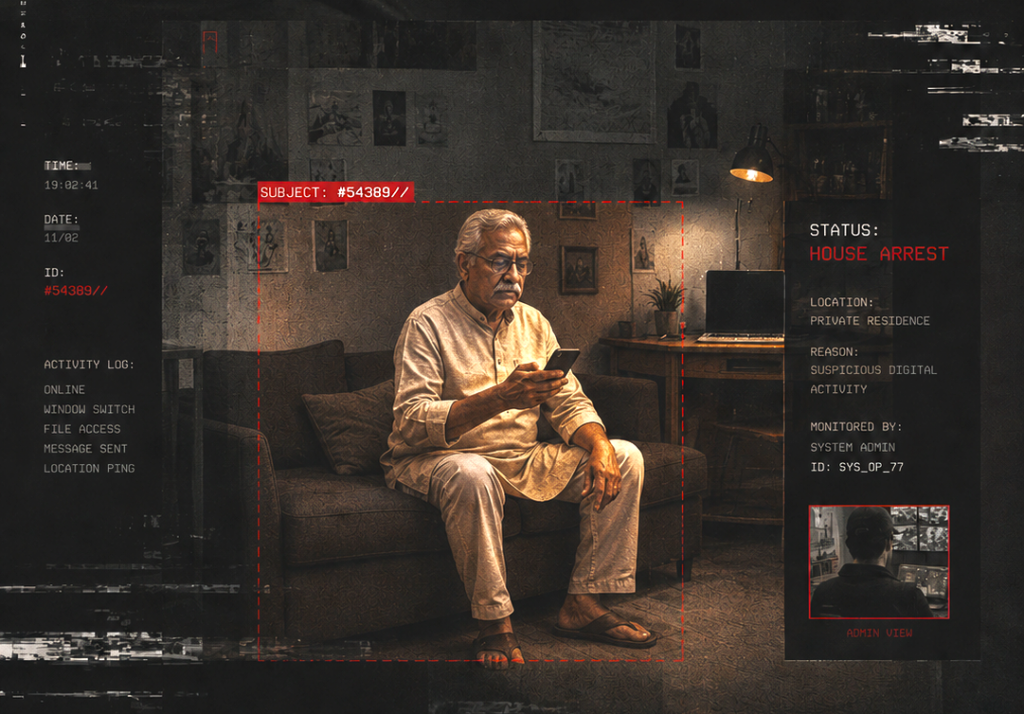


IN THE quiet corners of India’s metropolitan high-rises, a silent, invisible executioner is at work. It doesn’t use weapons, and it doesn’t break locks. Instead, it uses a glowing smartphone screen, a spoofed Skype ID, and the crushing weight of a fabricated state authority. This is the era of the “Digital Arrest”—a cross-border cyber-extortion phenomenon that has transformed from an occasional nuisance into a full-blown national security and psychological crisis.
Despite aggressive awareness campaigns by the Ministry of Home Affairs (MHA), repeated warning flashes from the Reserve Bank of India (RBI), and public advisories broadcasted by local police forces, the numbers continue to climb exponentially. Millions of rupees vanish into thin air every single day. The paradox is jarring: the victims are not the digitally illiterate or the gullible rural poor; they are retired bureaucrats, senior civil engineers, tech executives, doctors, and academics.
Why is an educated populace, fully aware of digital hygiene, surrendering their life savings without a physical struggle? The answer lies in the meticulous orchestration of institutional terror.
THE ANATOMY OF INSTITUTIONAL TERROR
The digital arrest scam succeeds because it does not feel like a cyber scam; it feels like an encounter with the terrifying, Kafkaesque machinery of the Indian legal system. Scammers do not mimic casual hackers; they mimic the state. They arrive clad in uniforms resembling the Narcotics Control Bureau (NCB), the Central Bureau of Investigation (CBI), or the Enforcement Directorate (ED), set against backdrops that perfectly replicate authentic police stations or government offices.
The psychological trap relies on three pillars:
1. Immediate Crisis Construction: The victim is told a contraband parcel (usually containing drugs, forged passports, or illegal currency) has been intercepted in their name.
2. The Weaponization of Shame: By linking the victim to severe anti-national offenses like money laundering or narcotics trafficking, the scammers leverage societal shame. The victim’s immediate instinct is to keep the matter completely confidential to protect their family’s honor.
3. The Isolation Protocol: Under the guise of a “virtual custody order,” victims are ordered to keep their cameras on 24/7, forbidden from disconnecting the call, speaking to family members, or consulting a lawyer.
Once the victim is psychologically broken down over hours—sometimes days—comes the “resolution”: a demand for a massive financial transfer into a “government safe-holding account” for verification, with a promise of a refund once their innocence is proven. The refund, predictably, never comes.
Story 1
The 48-Hour Siege of a Retired Professional
Chandra was shown an official-looking warrant bearing his Aadhaar details, accusing him of laundering money for a cartel. For 48 continuous hours, Chandra was kept under “visual surveillance” via Skype. He was forbidden from leaving his study or speaking to his wife in the next room. Exhausted, terrified, and stripped of his critical thinking faculties through sleep deprivation, Chandra transferred Rs 85 lakhs—his entire retirement corpus—to three separate bank accounts before the line went dead. ll

Story 2
The Belagavi Business Shockwave

Fraudsters impersonating a high-ranking central investigator linked his profile to a high-profile corporate money laundering case. Over weeks of simulated judicial proceedings and deepfake video calls, the octogenarian was systematically coerced into liquidating his lifelong fixed deposits and blue-chip equity holdings, transferring a monumental ₹15.45 crores into multiple mule accounts before the psychological spell was finally broken.

Ultimately, the digital arrest crisis is not a failure of intelligence, but a tragic exploitation of civic compliance
Law enforcement agencies cannot serve warrants or summons via WhatsApp or Skype demanding immediate compliance. A formal summons must be served physically or through registered electronic means

The government’s current counter-strategy relies heavily on informational advisories: SMS blasts stating “Police will never contact you over video call.” While well-intentioned, these measures fail because they address a rational brain, whereas the scam operates entirely within an induced state of primal panic.
When a person is told their freedom and reputation are hanging by a thread, the brain enters a fight-or-flight mode. The scammers intentionally create cognitive overload, leaving no psychological room for the victim to recall a standard government text message. Furthermore, systemic trust in institutional processes in India often carries an undercurrent of fear; citizens are conditioned to comply immediately with uniform-clad authority figures rather than questioning their credentials.

THE PATH FORWARD: STRUCTURAL AND LEGISLATIVE SHOCK THERAPY
To dismantle this multi-million dollar industry, India must move past basic awareness campaigns and enforce aggressive structural roadblocks:
Telecom and VoIP Hardening: The Department of Telecommunications (DoT) must implement absolute blocks on international spoofed calls displaying Indian CLI (Calling Line Identification) through initiatives like Sanchar Saathi.
Platform-Level Safeguards: Following recent Ministry of Home Affairs (MHA) directives, intermediaries like WhatsApp must deploy AI-powered impersonation detection and hard-block specific device IDs (IMEIs) rather than just banning dispensable SIM numbers.
Real-time Banking Halts: The financial ecosystem must deploy AI-driven anomaly detection. If a senior citizen suddenly liquidates stable investments to make massive, rapid transfers to unknown, newly opened current current/mule accounts, banks must enforce a mandatory “cooling-off” hold.
THE LEGAL REALITY CHECK
What the Law Actually Says
To protect yourself and your family, it is crucial to understand the strict boundary lines of Indian criminal procedure. No law enforcement agency has the legal sanction to isolate you virtually.
No Video Custody: Neither the CrPC nor the newly implemented Bharatiya Nagarik Suraksha Sanhita (BNSS) recognizes any concept of “Digital Arrest” or “Virtual Custody.” The Rajasthan High Court cleanly affirmed this legal boundary, stating that there is no provision for law enforcement to conduct arrests or judicial proceedings via video calls.
Physical Warrants Only: Law enforcement agencies cannot serve warrants or summons via WhatsApp or Skype demanding immediate compliance. A formal summons must be served physically or through registered electronic means, providing adequate time to respond.
No Financial Settlements over Calls: No government agency—be it the CBI, Customs, Income Tax, or ED—will ever ask a citizen to transfer money to a private bank account for “verification” or “safe custody.” All financial penalties or attachments are done through formal, written institutional bank mandates.
THE LEGAL FRAMEWORK
The Statutes Weaponized Against Cyber-Extortionists
When a scammer initiates a digital arrest, they violate multiple stringent provisions of Indian criminal and cyber law. Understanding these specific sections empowers citizens to recognize these acts as severe, non-bailable criminal offenses.
Impersonating a Public Servant (Section 204 BNS): Scammers dressing in uniforms or using fake ID cards/letterheads of the CBI, NCB, or Police violate Section 204 of the Bharatiya Nyaya Sanhita (BNS), 2023 (formerly Section 170 IPC), which carries rigorous imprisonment.
Extortion by Fear of Accusation (Sections 308 & 311 BNS): Threatening immediate jail time or public shaming to force a financial transfer violates Section 308 and 311 of the BNS (formerly Sections 384 and 389 IPC). Section 311 specifically penalizes putting a person in fear of an accusation of an offense punishable with death or life imprisonment (such as narcotics trafficking or money laundering) to commit extortion.
Cheating by Personation via Computer Resources (Section 66D, IT Act): Using spoofed VoIP calls, fake Skype IDs, deepfake videos, or altered digital avatars to hide identity and cheat the victim carries up to 3 years of imprisonment under Section 66D of the Information Technology Act, 2000.
Organized Crime Framework (Section 111 BNS): Because these scams operate out of coordinated international syndicates using structured “mule account” networks, they are increasingly classified under Section 111 (Organized Crime) of the new BNS framework, inviting severe, non-bailable penalties on par with economic sabotage.
DISMANTLING THE PSYCHOLOGY OF COMPLIANCE
Ultimately, the digital arrest crisis is not a failure of intelligence, but a tragic exploitation of civic compliance. The citizens being targeted are those who respect the law; their inherent desire to cooperate with authority is turned into a weapon against them. As long as our collective response to a uniform is absolute submission born out of fear, scammers will continue to harvest fortunes from living rooms.
India cannot police its way out of this epidemic purely through post-crime investigations. We must match the technological agility of transnational syndicates with rigid financial guardrails, absolute telecom accountability, and a public that is legally literate enough to recognize that a screen can never be a cell. The virtual cage only exists as long as we choose to stay on the line.