


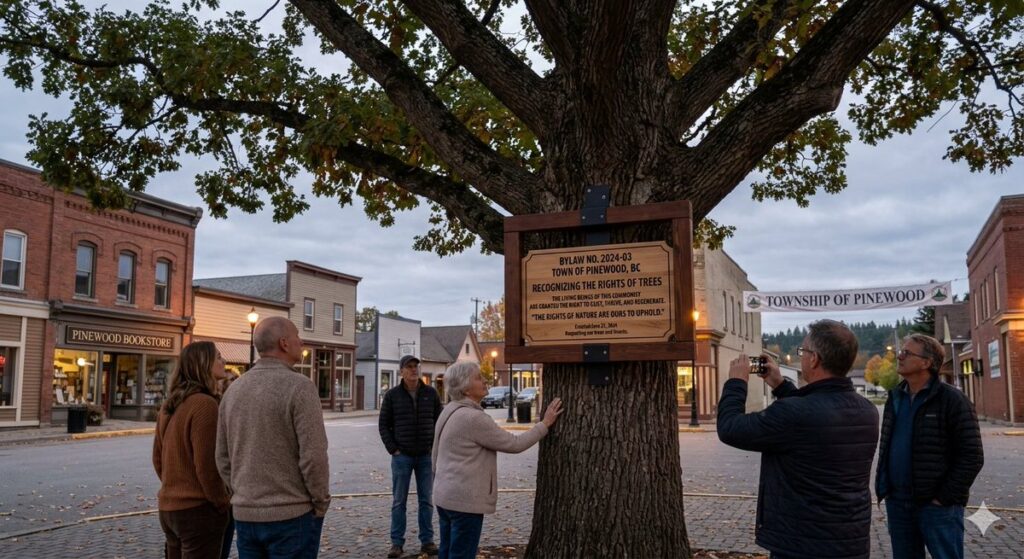

FOR CENTURIES, humanity has viewed forests as timber reserves, rivers as water supplies, and mountains as mineral deposits resources to be owned, exploited, and consumed. But a quiet revolution is reshaping that perspective. Across the world, a growing legal and environmental movement is arguing that nature should not merely be protected; it should possess rights of its own.
That vision has now found an unlikely champion in Grand Falls–Windsor, a small Canadian town in New Brunswick with a population of just over 2,000. In a landmark decision, the town has officially recognised trees as living beings, marking a significant shift in how local governance perceives the natural world.
Under the new resolution, trees are no longer regarded simply as public assets or municipal property. Instead, they are acknowledged as living entities deserving care, protection, and respect. The initiative also commits the town to public awareness programmes aimed at strengthening environmental stewardship and encouraging citizens to develop a deeper connection with nature.
The decision makes Grand Falls–Windsor the first municipality in Canada to endorse the Universal Declaration of the Rights of Trees, reinforcing the rapidly expanding global Rights of Nature movement. Rather than viewing ecosystems as commodities, this movement argues that forests, rivers, wetlands, and wildlife possess intrinsic value independent of their usefulness to humans.
The concept is not entirely new. In 2008, Ecuador became the first nation in the world to enshrine the Rights of Nature within its Constitution, recognising ecosystems as entities entitled to exist, regenerate, and flourish. Since then, courts and governments across several countries have explored similar legal frameworks, reflecting a growing recognition that environmental protection requires a fundamental shift in legal thinking.
THE PHILOSOPHY
The movement rests on three simple yet transformative ideas:
Trees are living beings and part of humanity’s shared natural heritage.
The survival of life on Earth depends upon healthy forests and thriving ecosystems.
Human beings have a moral responsibility to treat trees with dignity, care, and kinship rather than ownership.
The idea of recognising nature as a living entity is not unfamiliar to India. For centuries, Indian traditions have revered rivers, forests, mountains, and trees as sacred. While these beliefs have primarily existed within cultural and religious practices, Indian courts have occasionally reflected similar thinking in law.
In 2017, the Uttarakhand High Court declared the Ganga and Yamuna rivers to be living entities with legal rights. Although the ruling later faced practical and legal hurdles in implementation, it demonstrated the judiciary’s willingness to explore innovative approaches to environmental protection.
As India grapples with rapid urbanisation, deforestation, and climate change, the global conversation surrounding the legal rights of nature offers an opportunity to rethink environmental governance beyond traditional conservation measures.

BEYOND CONSERVATION
The decision by Grand Falls–Windsor is symbolic, but symbolism often shapes the future of law. It represents a transition from an era that viewed nature as a resource to be managed toward one that recognises ecosystems as partners in human survival.
Whether more governments follow this path remains uncertain. Yet one message is becoming increasingly clear: protecting nature may no longer be enough. The future may depend on recognising that humanity is not the owner of the Earth—but one member of a much larger living community.ll