


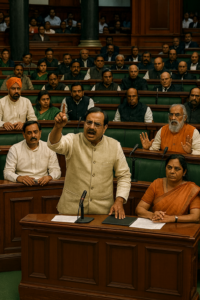
The debate gained momentum after Prime Minister Narendra Modi referred to it as the “soul of Bharat” and criticised what he viewed as its marginalisation under previous Congress-led governments. Rajasthan’s recent initiative to give the national song a formal place alongside the national anthem has further intensified public attention.
The 150th anniversary of Vande Mataram has revived a nationwide discussion on the song’s origins, significance, and political role. The debate gained momentum after Prime Minister Narendra Modi referred to it as the “soul of Bharat” and criticised what he viewed as its marginalisation under previous Congress-led governments. Rajasthan’s recent initiative to give the national song a formal place alongside the national anthem has further intensified public attention.
Historical Context and Shifting Expectations
Composed by Bankim Chandra Chattopadhyay and later musically rendered by Rabindranath Tagore for the 1896 Indian National Congress session, Vande Mataram soon became a unifying slogan during the freedom struggle. Yet, by the early 20th century, disagreements emerged. Several Muslim leaders objected to portions of the poem that invoked the divine in a form they believed conflicted with monotheistic doctrine.
Responding to these concerns, Mahatma Gandhi suggested in 1931 that only the first two stanzas—those without overt religious imagery—should be sung on political and public occasions. This approach eventually shaped the general understanding that informed later constitutional deliberations.
Muslim Concerns and Increasing Divergence
The Muslim League repeatedly resisted attempts to make singing Vande Mataram mandatory, maintaining that specific lines conveyed imagery incompatible with Islamic belief. Legislative bodies in provinces such as Bihar, the United Provinces, and Bengal frequently grappled with controversies over whether schools and government events should require its recitation.
Interpretations of Bankim’s broader writings, especially references to idolatry, added another layer of tension. Though many scholars argue these views were unrelated to the poem itself, the symbolism of “Mother” in Anandamath nonetheless became a contested political issue during the 1930s.
The Constituent Assembly’s Compromise
As Independence approached, Congress members differed on whether Vande Mataram should be declared the national anthem. While many supported the idea, objections from minority representatives made consensus difficult. Jawaharlal Nehru ultimately proposed a middle path: Jana Gana Mana would be recognised as the national anthem, and Vande Mataram would receive official status as the national song, with only its initial two stanzas designated for formal and state functions.
This carefully balanced decision prevented further divisions within the Constituent Assembly and has remained the accepted arrangement since.
Contemporary Renewed Debate
The political meaning of Vande Mataram continues to evolve. Periodic disputes arise whenever governments attempt to reinterpret its constitutional standing or mandate its singing. Rajasthan’s recent policy shift—along with Prime Minister Modi’s comments—has once again placed the song at the centre of national discussion.
For many Indians, Vande Mataram symbolizes the sacrifices of the freedom struggle. For others, it is a cultural emblem that requires sensitive handling in a diverse, plural society. As India marks 150 years since the poem’s creation, the discussions surrounding it reveal deeper questions about identity, nationalism, and collective memory.
We strive to make a lasting impact on India’s policy and planning landscape through fair, unbiased, and incisive research based journalism.
But we can’t do it alone.
Together, we can create a better India, where policies are fair, planning is unbiased, and the truth prevails. Your contribution matters, and we shall be immensely grateful for your support.