Close Menu
    What's Hot

    Right to Work: Fundamental Right or Constitutional Aspiration?

    August 21, 2026

    Police Cannot Investigate PCPNDT Act Offences

    August 21, 2026

    Right to Marry Is a Human Right

    August 21, 2026
    Facebook X (Twitter) Instagram
    Trending
    • Right to Work: Fundamental Right or Constitutional Aspiration?
    • Police Cannot Investigate PCPNDT Act Offences
    • Right to Marry Is a Human Right
    • DOG EVIDENCE NOT ENOUGH
    • RITUALS BEFORE REGISTRATION MATTER
    • THE DIGITAL ARREST
    • LOVE IN THE AGE OF AI
    • when TREES become CITIZENS
    Facebook X (Twitter) Instagram
    Legal MitraLegal Mitra
    Demo
    • Home
    • Editorials
    • Articles Category
      • Law Focus
      • Law to Life
      • Law Tech
      • Cover Story
      • HOUMOUR
      • Legal Desk
      • International
      • Matrimony
      • Women
      • Cyber Crime
    • Magazine Issues
    • Authors
    Legal MitraLegal Mitra
    Home » News » Between Welfare and Vote Banks: The Supreme Court’s Freebies Warning
    Featured

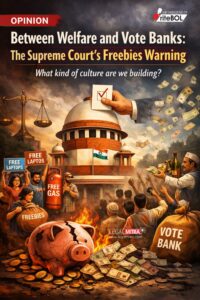
    Between Welfare and Vote Banks: The Supreme Court’s Freebies Warning

    Rare Verdict in Patna
    Facebook Twitter Pinterest LinkedIn Telegram Tumblr Email
    Share
    Facebook Twitter LinkedIn Pinterest Email

    India’s highest court has asked a question that cuts deeper than fiscal policy — what kind of culture are we building?

    The provocation is not abstract. It comes from the increasingly familiar spectacle of governments unlocking the treasury just before elections, distributing benefits that look less like policy and more like political confetti. The Supreme Court’s sharp rebuke of this “freebies culture” is not merely about economics — it is about the direction of the republic itself.

    While hearing a challenge involving electricity subsidies, the bench led by Chief Justice Surya Kant, along with Justices Joymalya Bagchi and Vipul Pancholi, delivered a pointed observation: states today appear to be doing two things with alarming enthusiasm — paying salaries and distributing largesse — while development quietly waits its turn.

    That remark, understated as it sounds, carries a serious accusation. Governance, it suggests, is being replaced by appeasement.

    Welfare or Political Sedation?

    No serious system of governance can deny support to the vulnerable. The Court made that clear. Helping those who genuinely cannot pay for basic necessities is not only defensible — it is essential.

    The problem arises when compassion dissolves into indiscriminate distribution.

    When benefits flow without economic distinction, the moral argument for welfare begins to weaken. Assistance meant for the needy morphs into universal entitlement. Policy blurs into patronage. And political messaging quietly replaces economic reasoning.

    The Court’s unease is simple but profound: when the state stops differentiating between those who need support and those who can pay, is it still welfare — or merely electoral strategy dressed in moral language?

    The Hidden Economic Cost

    The economic concern is not theoretical. Most Indian states already operate under tight fiscal constraints. Yet many continue to announce expansive giveaways — free electricity, free goods, free services — as if public finance were a bottomless well rather than a fragile balancing act.

    The Court’s warning is blunt: development suffers when resources are diverted from long-term growth to short-term popularity.

    Infrastructure stalls. Employment generation slows. Productive investment shrinks. And public spending shifts from building capacity to maintaining dependency.

    In other words, the state becomes a distributor rather than a developer.

    ALSO READ

    भारत–अमेरिका व्यापार समझौता: किसानों के लिए अवसर या संकट?


    The Work Culture Question

    Perhaps the Court’s most uncomfortable observation is also its most socially consequential — the impact on work participation.

    If the state provides everything from food to transport to utilities without economic targeting, what incentive structure does that create? A system built on continuous subsidies risks normalising reliance instead of encouraging participation.

    This is not an argument against welfare. It is an argument against designing welfare in a way that gradually replaces productivity with entitlement.

    When public policy rewards dependence more reliably than effort, the damage is not immediate — but it is cumulative. Over time, the work ethic that drives economic mobility erodes quietly, almost invisibly.

    The Need for Definition — and Discipline

    One of the Court’s most constructive suggestions is also its most overdue: define what a “freebie” actually is.

    Without a clear distinction between legitimate welfare and political giveaways, every subsidy can be justified and every criticism dismissed. A structured framework — potentially shaped by experts from government, policy institutions, and the Election Commission — could impose long-missing clarity.

    Because the real issue is not generosity. It is accountability.

    Public money, after all, is not charity. It is collective capital. Its use demands economic logic, not electoral timing.

    The Real Question India Must Answer

    The Court’s central question lingers: what kind of culture are we creating?

    A culture of protection for the vulnerable is a mark of a civilised society.
    A culture of perpetual distribution without productivity is something else entirely.

    The difference lies in intent, design, and discipline.

    If governance becomes a competition of giveaways, fiscal stability weakens, development slows, and citizenship gradually transforms from participation to expectation.

    The warning from the Supreme Court is not just legal commentary. It is a reminder that economic policy shapes social behaviour — and social behaviour shapes the future of the nation.

    India must decide whether public policy will build capacity… or simply purchase consent.

    READ MORE

    VIRTUAL CRIMES

    Subscribe Us 

    Facebook Twitter Youtube

    We strive to make a lasting impact on India’s policy and planning landscape through fair, unbiased, and incisive research based journalism. 
    But we can’t do it alone.
    Together, we can create a better India, where policies are fair, planning is unbiased, and the truth prevails. Your contribution matters, and we shall be immensely grateful for your support.

    Support LegalMitra
    Freebies Political Sedation Supreme Court
    Share. Facebook Twitter Pinterest LinkedIn Tumblr Email

    Related Posts

    Right to Work: Fundamental Right or Constitutional Aspiration?

    August 21, 2026

    Police Cannot Investigate PCPNDT Act Offences

    August 21, 2026

    Right to Marry Is a Human Right

    August 21, 2026

    HC Orders Immediate Steps to Save Sonam Wangchuk’s Life

    July 16, 2026

    ‘Mahaprabhu Jagannath’ Makers Move SC Against HC Ban Ahead of Release

    July 16, 2026

    SC Stays Madras HC’s Blanket Ban on Cow Slaughter in Tamil Nadu

    July 16, 2026
    Leave A Reply Cancel Reply

    Top Posts

    No Maintenance for Working Wife, Rules Supreme Court

    March 22, 2025344 Views

    The Fasli Year

    July 13, 2023272 Views

    HANUMAN’S JOURNEY OF GUIDANCE

    June 24, 2023165 Views
    Categories
    • Agastya Sharma (2)
    • August 2023 (19)
    • August 2024 (7)
    • Cover Story (22)
    • Cyber Crime (3)
    • Digital Classics (3)
    • Editorial (7)
    • Featured (61)
    • Featured Videos (3)
    • Feb-March 2024 (23)
    • Feb-March 2026 (3)
    • February 2024 (2)
    • Gadgets (1)
    • HOUMOUR (4)
    • International (14)
    • January 2024 (27)
    • June – July 2024 (38)
    • June 2025 (7)
    • June-2023 (10)
    • June-July 2026 (7)
    • Khushboo Sharma (2)
    • Latest in Tech (3)
    • Law Focus (15)
    • Law Medics (2)
    • Law Tech (8)
    • Law to Life (44)
    • Legal Desk (6)
    • Legal Mitra – E Magazine (1)
    • Maarisha Sharma (1)
    • March 2025 (11)
    • May-2023 (16)
    • Most Recent (146)
    • New Arrivals (69)
    • News (60)
    • November 2024 (6)
    • Oct-Nov 2025 (10)
    • October 2023 (8)
    • October 2024 (9)
    • riteBOL (97)
    • Ritesh Sharma, Editor (26)
    • Shipra Sharma (3)
    • Tech & Work (1)
    • Todays Picks (1)
    • Trending (6)
    • Uncategorized (5)
    • Women (8)
    Don't Miss

    Right to Work: Fundamental Right or Constitutional Aspiration?

    The Supreme Court has raised a larger constitutional question over whether the statutory right to…

    Police Cannot Investigate PCPNDT Act Offences

    August 21, 2026

    Right to Marry Is a Human Right

    August 21, 2026

    DOG EVIDENCE NOT ENOUGH

    July 17, 2026
    Stay In Touch
    • Facebook
    • YouTube
    • TikTok
    • WhatsApp
    • Twitter
    • Instagram
    Most Popular

    No Maintenance for Working Wife, Rules Supreme Court

    March 22, 2025344 Views

    The Fasli Year

    July 13, 2023272 Views

    HANUMAN’S JOURNEY OF GUIDANCE

    June 24, 2023165 Views
    Our Picks

    Right to Work: Fundamental Right or Constitutional Aspiration?

    August 21, 2026

    Police Cannot Investigate PCPNDT Act Offences

    August 21, 2026

    Right to Marry Is a Human Right

    August 21, 2026
    Legal Mitra
    Facebook X (Twitter) Instagram YouTube
    • Home
    • About Legal Mitra
    • Editorials
    • Article Categories
    • Contact Us
    © 2026 Legal Mitra. Designed by CREADIG.

    Type above and press Enter to search. Press Esc to cancel.

    Go to mobile version