Court Condemns Breakdown of Professional Conduct
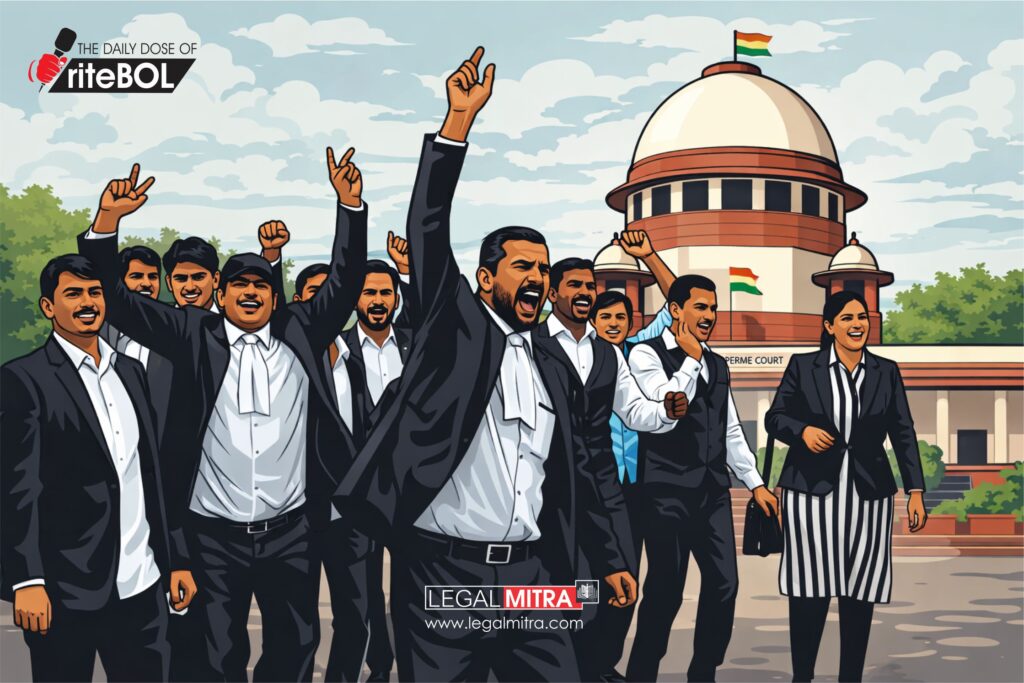
The Supreme Court of India came down heavily on members of the legal fraternity after acts of vandalism and intimidation were reported in connection with a toll plaza dispute in Uttar Pradesh. The Court observed that the legal profession, once regarded as noble, had been tarnished by what it described as outright “hooliganism,” reflecting a disturbing erosion of professional ethics.
Incident That Triggered the Controversy
The matter had originated from a January 14 incident at a toll plaza on the Lucknow–Sultanpur highway, where a lawyer, Ratnesh Shukla, had allegedly refused to pay toll charges. An altercation had ensued, escalating into a physical scuffle in which toll plaza staff were accused of assaulting him.
Following the incident, a police complaint was filed, and toll employees were arrested, setting off a chain reaction that extended far beyond the original dispute.
Bar Resolution and Retaliatory Violence
In response, a local bar association had passed a resolution directing that no lawyer should represent the accused toll employees. However, when one advocate chose to defy this informal boycott and agreed to represent them, his office was vandalised, and his furniture was set on fire by fellow lawyers.
This escalation from professional disagreement to outright violence was viewed by the Court as deeply alarming.
Supreme Court’s Strong Observations
A bench comprising Justices Vikram Nath and Sandeep Mehta expressed shock at the developments, describing the situation as a “sorry state of affairs.” The Court praised the advocate who chose to represent the accused, terming his actions as “brave” in the face of collective pressure.
It was emphasized that while professional solidarity among lawyers is understandable, it cannot justify acts of violence, coercion, or obstruction of justice. The Court categorically stated that such conduct undermines the very foundation of the legal system.
Directions and Institutional Accountability
The Court granted bail to the accused toll plaza employees and ordered the transfer of the case to Delhi, directing Uttar Pradesh police to ensure their safety. It also called upon the Bar Council of India to take disciplinary action against those involved in the misconduct.
Further criticism was directed at the Bar Council of Uttar Pradesh, which had sought invocation of the National Security Act against the toll employees. The Court termed this response disproportionate, noting that the underlying incident stemmed from what was essentially a minor altercation.
Larger Implications
The episode has exposed a serious institutional failure within the legal profession, where enforcement of informal group loyalty was allowed to override the fundamental right to legal representation. The Court’s intervention sends a clear message: when lawyers themselves resort to intimidation and violence, they do not just break the law—they damage the credibility of the entire justice system.
We strive to make a lasting impact on India’s policy and planning landscape through fair, unbiased, and incisive research based journalism.
But we can’t do it alone.
Together, we can create a better India, where policies are fair, planning is unbiased, and the truth prevails. Your contribution matters, and we shall be immensely grateful for your support.

