


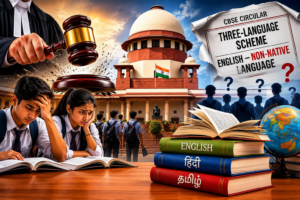
 The Supreme Court has questioned the CBSE’s classification of English as a “non-native language,” observing that the language has been part of India’s social and administrative fabric for over three centuries. The Court also raised concerns over the continued use of the colonial term “native” in official policy documents.
The Supreme Court has questioned the Central Board of Secondary Education’s (CBSE) decision to classify English as a “non-native language” under the three-language scheme, observing that the language has been spoken and used in India for more than 300 years and cannot be viewed solely through a colonial lens.
During the hearing, the Bench expressed reservations over placing English in the same category as foreign languages such as German, Spanish, Arabic and French, particularly when English continues to serve as an official language and a primary medium of administration in several Indian States.
The Court also took exception to the use of the term “native” in the CBSE circular, describing it as a colonial-era expression whose relevance in present-day India deserves reconsideration. The Bench remarked that the terminology used in educational policy should reflect India’s constitutional values and contemporary linguistic realities.