


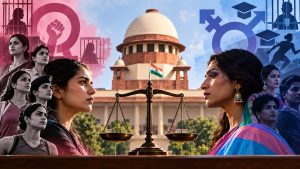
Women’s Declaration International India has approached the Supreme Court, seeking safeguards for legal protections reserved for women. The Centre has been asked to respond to concerns involving reservations, prisons, sports and sex-specific protections under the amended transgender law
The Supreme Court has been approached by women’s organisation Women’s Declaration International India (WDII), which has challenged aspects of the Transgender Persons (Protection of Rights) Act, 2019, as amended in 2026, over their potential impact on constitutional and statutory protections available to women.
A three-judge Bench comprising Chief Justice of India Surya Kant and Justices Joymalya Bagchi and V. Mohana issued notices to the Union Ministries of Social Justice and Empowerment, Law and Justice, and Health and Family Welfare, seeking their responses to the petition. The plea has been tagged with other pending challenges to the 2026 amendment.
Representing the organisation, senior advocate Amit Sibal submitted that the petition was intended to address concerns specific to women’s rights. It was clarified that the organisation did not oppose transgender persons’ right to equality or recognition, but sought to ensure that protections and benefits specifically provided to women were not undermined.
The petition has questioned whether legal recognition of gender identity should automatically confer eligibility for every benefit or protection reserved for women under particular laws.
Reservations, Sports and Privacy Under Examination
Several areas of potential legal conflict have been identified in the petition, including women’s reservations in local bodies, participation in women’s sporting competitions, accommodation in women’s prisons and safeguards governing the arrest, search and questioning of women.
Concerns have also been raised regarding access to women-only facilities and the privacy and dignity of women in settings involving intimate care or physical searches.
The petitioner has argued that the distinction between biological sex and gender identity requires legal consideration when eligibility for sex-specific protections is determined. Questions have also been raised over whether transgender persons should receive separate reservation arrangements or be permitted to contest seats specifically reserved for women in local bodies.
During the hearing, Justice Bagchi observed that the petition appeared to raise a distinct perspective, although the validity of the amended legislation was already under consideration in other proceedings. The concern that additional petitions could delay the existing cases was also noted.
Solicitor General Tushar Mehta informed the court that the Centre’s response was being prepared in the connected proceedings and that the concerns raised in the present petition would also be addressed.