The Supreme Court has highlighted the unequal options available to lawyers and judges amid Delhi’s worsening air pollution, observing that lawyers can appear virtually while judges are required to attend court in person.
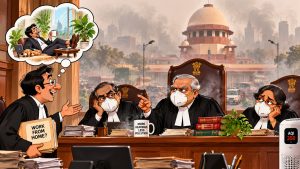
Air pollution in Delhi-NCR became the subject of a pointed exchange in the Supreme Court on Wednesday, October 28, 2026, when Justice Vikram Nath observed that lawyers could avoid polluted air by working from home, whereas judges had no similar option while conducting court proceedings in person.
The remark was made during the hearing of a petition concerning pollution, as a scheduling dispute arose over whether the matter should be listed before or after Diwali.
Senior advocate Indira Jaising requested that the case be listed on November 17, after the festival. However, an opposing counsel pressed for an earlier hearing, citing concerns that pollution levels in Delhi and neighbouring areas could deteriorate after Diwali.
Jaising remarked that pollution remained severe both before and after the festival and suggested that the matter could be heard later. In response, Justice Nath observed that air quality could worsen following Diwali and indicated that an earlier hearing would therefore be preferable.
When Jaising pointed out that lawyers appearing in person would also have to face the polluted air, Justice Nath highlighted the availability of virtual appearances for advocates.
“You have the option of avoiding pollution by staying at home, but we cannot do that,” the judge observed, referring to the possibility of lawyers attending proceedings through video conferencing.
Delhi’s Air Quality Raises Concern
The exchange took place against the backdrop of recurring winter pollution in the national capital. Historical air-quality data cited in the report showed that Delhi’s average Air Quality Index (AQI) had risen from 268 on October 18, 2025, to 345 on Diwali, October 20, before reaching 353 on October 22.
In 2026, the first stage of the Graded Response Action Plan (GRAP) was implemented across Delhi-NCR on October 21 by the Commission for Air Quality Management (CAQM). Delhi’s average AQI was recorded at 244 at 2 pm that day and 245 at 4 pm. It subsequently stood at 197 at 4 pm on October 27 before rising to 228 at 7 am on October 28.
Vehicular emissions, industrial activity, construction dust, stubble burning and waste burning have repeatedly been identified as contributors to the region’s pollution crisis.
Firecracker Restrictions Remain Under Judicial Scrutiny
The Supreme Court has continued to monitor air pollution and the regulation of firecrackers in Delhi-NCR. Over the years, concerns have been raised about inadequate enforcement of restrictions and the potential consequences of pollution for children, elderly persons and people with existing health vulnerabilities.
In earlier proceedings, the court questioned whether religious practices could justify activities that endangered public health. Restrictions on firecracker sales and use have subsequently been reconsidered in light of environmental concerns, scientific evidence and religious sentiments.
On September 30, 2026, a bench comprising Justices M. M. Sundaresh and Augustine George Masih reportedly declined to impose a complete ban on firecrackers or permit their unrestricted use throughout the day. A subsequent hearing on October 12 also brought enforcement concerns before the court, with questions being raised about the religious justification for bursting firecrackers.
The latest courtroom exchange has once again drawn attention to the practical difficulties created by Delhi’s pollution crisis. While virtual hearings can offer lawyers some flexibility, the observation by Justice Nath has highlighted that the judiciary’s working arrangements may leave judges with fewer options to avoid exposure.
The broader challenge remains unresolved: effective pollution control requires more than judicial monitoring, with consistent enforcement and sustained action against the sources of pollution being essential to protecting public health.
Domestic Violence Complaint Also Rejected
In 2013, a complaint was filed by Advani under the Protection of Women from Domestic Violence Act, 2005, against Kapadia and other members of Khanna’s family. Monthly maintenance and accommodation in a three-bedroom flat in Mumbai’s Bandra area were among the reliefs sought.
The complaint was quashed by the Bombay High Court in 2015. It was held that Advani’s relationship with Khanna did not qualify as a relationship in the nature of marriage for the purposes of the domestic violence law. It was also observed that Khanna’s family members could not be proceeded against in the circumstances described, as Advani had not lived with them.
The latest dismissal marks another setback for Advani’s efforts to obtain judicial recognition of her alleged relationship with the actor. The proceedings also highlight the distinction under Indian law between a claimed live-in relationship and a relationship that satisfies the legal requirements for recognition as a marriage or as a relationship in the nature of marriage under the domestic violence legislation.
We strive to make a lasting impact on India’s policy and planning landscape through fair, unbiased, and incisive research based journalism.
But we can’t do it alone.
Together, we can create a better India, where policies are fair, planning is unbiased, and the truth prevails. Your contribution matters, and we shall be immensely grateful for your support.
